RFP Response Checker: Checks Before You Approve
It is late in the evening, twelve hours before an enterprise procurement portal closes, and a proposal team is consolidating a two-hundred-page response across four business units. Section 3.2.4 demands an ISO 27001 certificate with an expiration date past next quarter, but the attached file belongs to an outdated subsidiary entity. Meanwhile, a technical lead pasted a placeholder promise regarding a five-minute disaster recovery failover that contradicts the legal team’s master service agreement. These discrepancies rarely stem from a lack of technical capability; they occur because manual proposal reviews under strict deadlines rely on cognitive scanning speed rather than structural validation.
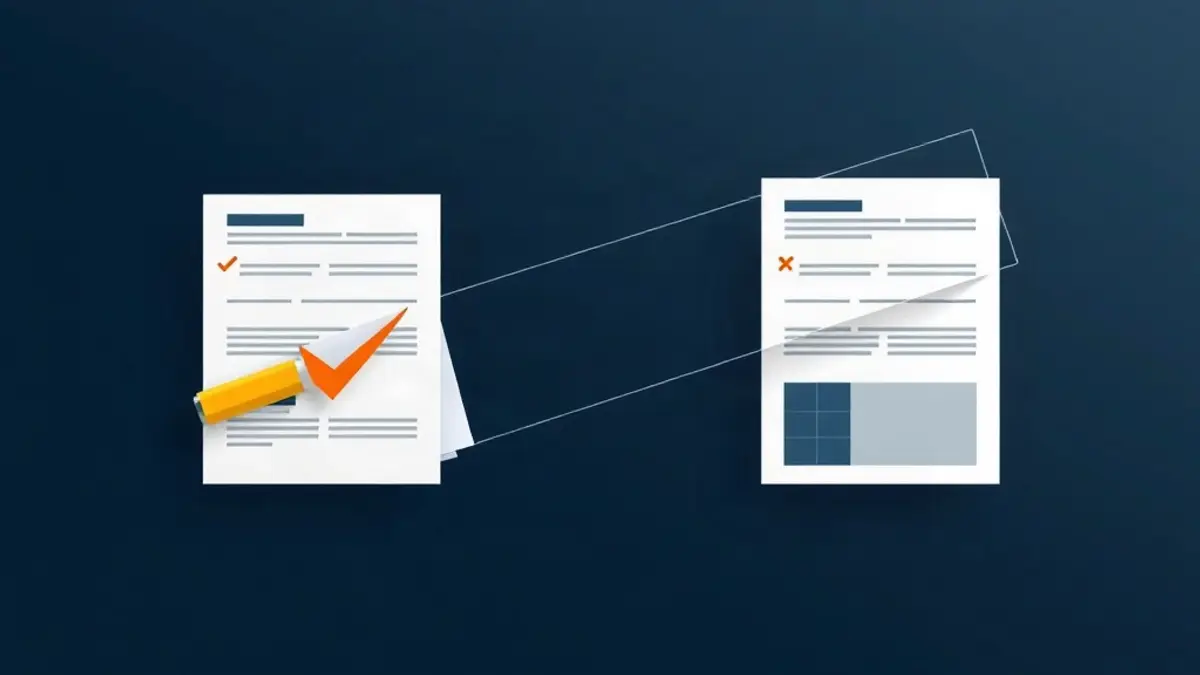
An RFP response checker is a software tool or structured validation system that evaluates proposal documents against formal solicitation requirements prior to submission. It identifies missing mandatory documents, unverified capability claims, word count violations, contradictory statements, and unaddressed commercial clauses, ensuring the response aligns with evaluation criteria without relying on manual spot-checking.
The Anatomy of Proposal Quality Failures
Formal bids and tenders fail at the evaluation stage for predictable reasons. Procurement officers operate under strict evaluation rubrics where non-compliance with explicit instructions triggers immediate disqualification or heavy point deductions. When an enterprise submits a multi-volume response, errors usually fall into two broad buckets: structural non-compliance and evidentiary gaps. Structural failures include missed mandatory attachments, exceeded word limits, altered pricing tables, or ignored submission instructions. Evidentiary failures occur when a response uses generic, marketing-oriented text that fails to prove the bidder meets the baseline criteria.
The cost of these errors is absolute. Evaluators in public sector and enterprise procurement rarely contact bidders to request missing documents or clarify vague assertions unless formal clarification protocols permit it. If a proposal omits a required data protection policy or fails to state explicitly that the vendor accepts the buyer’s limitation of liability clause, the proposal scoring rubric reflects that omission immediately. Systematic quality checks replace last-minute guesswork with deterministic criteria verification.
What Is an RFP Response Checker?
An RFP response checker is a analytical software workflow that cross-references a completed bid response against the original Request for Proposal (RFP), Invitation to Tender (ITT), or Request for Quotation (RFQ). Rather than treating proposal editing as a basic spelling and grammar review, an automated checker treats the solicitation document as a binding set of explicit constraints. It parses instructions to identify mandatory clauses, submission deadlines, document requirements, and evaluation rubrics, then checks the draft response against those elements.
Modern validation platforms handle these tasks using localized parsing and artificial intelligence. Tools like the free tender analyzer allow bid teams to evaluate draft text, parse docx files, text-based PDFs, or plain text right within the browser without uploading corporate data to external servers. Advanced proposal quality review software extends this capability across entire team workspaces, comparing draft answers against verified organizational facts, past contracts, and executive policy repositories.
The Four Pillars of Systematic RFP Response Review
To perform a thorough proposal review, bid managers must evaluate responses across four specific vectors. Skipping any single vector leaves the submission exposed to scoring penalties or administrative rejection.
- Mandatory Compliance Verification: Ensuring every explicit “shall”, “must”, and “will” requirement in the tender is matched with a direct, unambiguous answer in the draft.
- Evidentiary Validation: Verifying that every claim made about corporate experience, headcount, certifications, software functionality, or performance metrics is supported by factual reference materials.
- Format and Constraint Adherence: Auditing character limits, page counts, file structure, naming conventions, and layout rules against tender guidelines.
- Commercial and Risk Audit: Identifying unapproved risk transfers, unreviewed indemnity language, non-standard payment terms, or unrealistic service level agreements (SLAs).
The table below outlines how these pillars operate across typical review cycles:
| Review Pillar | Primary Objective | Key Risk Mitigated | Key Output |
|---|---|---|---|
| Mandatory Compliance | Match every tender directive to a complete response | Administrative rejection for missing items | Verified compliance matrix |
| Evidentiary Audit | Confirm all claims refer to real company artifacts | Scoring penalties for unsubstantiated claims | Citation map & gap list |
| Constraint Validation | Verify word limits, page caps, and file names | Portal rejection or automated truncation | Line-item constraint log |
| Commercial Risk Audit | Align response with risk appetite and legal terms | Unfunded liabilities and contract breach | Commercial exception register |
Technical Compliance: Checking Requirements Against Mandatory Criteria
Technical compliance forms the baseline of any proposal response quality checker workflow. Solicitation documents use specific modal verbs to signal binding conditions. Terms such as “shall”, “must”, “is required to”, and “will” represent pass/fail conditions. If an RFP states that “the contractor shall maintain a local support office in the target region,” a response that states “our global support desk assists clients worldwide” represents a non-compliant answer that evaluators will penalize.
An automated RFP compliance checker scans both the solicitation and the response text to build a line-item traceability matrix. It maps requirement IDs directly to section numbers in the proposal. Where a draft fails to answer a requirement directly, the system flags the missing linkage. For a detailed breakdown of how to prepare your proposal for final submission, read our detailed guide to submission readiness checks.
Evidentiary Audit: Verifying Unsubstantiated Claims
Evaluators reward verifiable evidence over decorative language. Broad statements like “we are a industry-leading provider with state-of-the-art security” earn minimal credit on objective scoring scales. Evaluators expect specific details: certification numbers, audit dates, deployment histories, and quantifiable performance outcomes.
The core principle behind reliable bid validation is evidence before eloquence. A robust proposal compliance checker does not invent certifications, reference clients, team sizes, or corporate policies when verifying text. Instead, it checks the draft against an approved repository of corporate facts—often referred to as a Company Brain—containing current certificates, case studies, resume archives, and policy documents. If the proposal text references a capability that lacks supporting documentation in the knowledge repository, the review system places an explicit marker in the text, requiring human sign-off before approval. Learn more about this methodology in our methodology for grounded AI proposal responses.
Structure, Formatting, and Word Count Constraints
Procurement teams enforce layout constraints to maintain fairness across competing bids and manage evaluator workload. Submitting a narrative that exceeds a five-hundred-word restriction can result in the evaluator discarding all text past the limit or rejecting the response section entirely.
Using a dedicated RFP word limit checker ensures that character, word, and page counts remain strictly within specified parameters across every section. Proposal teams should implement the following structural controls before lock-down:
- Character and Word Limits: Verify text lengths against both soft guidelines and hard portal entry caps, accounting for spaces and field formats.
- File Naming Rules: Confirm that every uploaded file follows the exact nomenclature required by the tender instructions (e.g.,
VendorName_Volume1_TechnicalResponse.pdf). - Required Attachments: Cross-check listed appendices, such as audited financial statements, disaster recovery plans, and ISO certificates, against actual file packages.
- Response Field Mapping: Ensure multi-part answers line up correctly with target online portal fields, preventing swapped answers during final data entry.
Commercial and Legal Risk Checks
Technical reviewers often focus heavily on functional specifications, leaving commercial terms under-scrutinized until right before the submission deadline. A thorough proposal final review must examine the commercial and legal commitments contained within the narrative response. A single sentence committing to “round-the-clock on-site support within two hours” can create severe operational liability if the baseline contract pricing only covers remote business-hour assistance.
An automated RFP response validator reviews text for flagged risk terms, non-standard indemnities, uncapped liabilities, non-standard payment windows, and explicit warranty promises. By highlighting these high-attention clauses during early draft reviews, the bid manager can escalate commercial conflicts to legal and executive leaders before the submission package reaches final sign-off.
Alignment with Evaluation Criteria and Scoring Rubrics
Evaluators do not score proposals based on general quality; they score them against the specific evaluation rubrics published in the tender instructions. In public sector procurement governed by frameworks such as FAR Subpart 15.3 on how proposals are evaluated, proposals must map directly to explicit evaluation factors and sub-factors.
An effective RFP response checker evaluates whether the draft content addresses the weightings established in the solicitation. If an RFP allocates heavy scoring weight to technical methodology and lower weight to company history, the proposal structure should mirror that emphasis. For practical guidelines on aligning narrative text with buyer scoring models, refer to our guide on mapping responses to RFP evaluation criteria.
The table below illustrates how evaluation factors map to validation checkpoints during a quality review:
(Note: The point allocations below serve as a hypothetical example of an evaluation rubric structure for illustrative purposes.)
| Evaluation Factor | Focus Area | Critical Checker Validation |
|---|---|---|
| Technical Solution | Architecture, features, implementation method | Validates functional assertions against core platform documentation |
| Past Performance | Relevant project histories, reference clients | Confirms case study dates, contract values, and scope similarities |
| Management & Key Personnel | Resumes, qualifications, team structures | Verifies staff certifications, roles, and experience statements |
| Commercial & Pricing | Cost models, SLAs, legal exceptions | Flags unapproved warranty commitments and payment terms |
Addenda and Change Tracking During the Review Phase
Procurement authorities frequently release tender addenda, formal responses to clarification questions, and updated scope documents while bid teams are actively drafting responses. A common source of compliance failure is submitting a proposal written against the original specification after an addendum modified a key requirement.
A comprehensive proposal quality review software platform tracks variations between document revisions. When a buyer publishes an addendum, the review system compares the modified requirement statements against the existing draft narrative. It flags responses that require updates, preventing the team from submitting responses based on superseded instructions.
Manual Review Protocols vs. AI Proposal Review Workflows
Traditional proposal review workflows rely on staged human review teams, often designated by color codes:
- Pink Team: Reviews key concepts, narrative direction, and initial storyboards against tender requirements.
- Red Team: Reviews the completed draft from the perspective of the buyer’s evaluation panel, scoring the content against the rubric.
- Gold Team: Performs final executive sign-off, reviewing commercial pricing, risk exceptions, and legal commitments.
While color-team reviews remain essential for strategic positioning, relying entirely on human readers for manual line-by-line validation introduces risk. Human reviewers experience cognitive fatigue, miss obscure attachment instructions, or overlook subtle phrasing differences in long text blocks. Combining human color-team reviews with an AI proposal reviewer provides continuous, objective baseline checks. The automated system handles word-count tracking, document verification, and requirement mapping, freeing human reviewers to focus on strategic positioning and executive messaging.
Step-by-Step Pre-Submission Review Process
Executing a structured, repeatable review process prevents last-minute submission errors. Teams should execute the following six steps prior to approving any formal bid response:
- Extract and Lock Requirements: Import the solicitation into a validation tool to generate an exhaustive list of mandatory directives, attachment requirements, and formatting rules.
- Run an Automated Compliance Audit: Process the complete draft through an RFP response checker to identify unanswered requirements, missing files, or broken cross-references.
- Perform an Evidentiary Audit: Cross-reference all claims, statistics, client names, and policy citations against your verified corporate knowledge base to mark unverified statements.
- Conduct Commercial and Legal Review: Audit draft responses for implicit commitments, contract exceptions, SLA modifications, or unapproved pricing terms.
- Execute Red Team Scoring: Have subject matter experts evaluate the verified draft against the published scoring rubric, identifying weak narrative areas.
- Final Constraint and Package Lock: Validate final word counts, page layouts, PDF rendering, file naming, and digital signature requirements prior to portal upload.
Verification Protocols for Subcontractor and Partner Input
Complex enterprise bids often require contributions from joint venture partners, subcontractors, and external vendors. Integrating third-party content introduces compliance risks, as partner contributions may use inconsistent terminology, make unsupported technical claims, or omit required certifications.
An RFP response quality checker evaluates external partner inputs against the main tender specifications before those sections are merged into the master proposal. The system verifies that subcontractor capabilities align with prime contractor commitments, that partner staff resumes meet minimum experience requirements, and that partner policy documents match the prime contractor’s compliance baselines.
Frequently asked questions
What is the difference between an RFP compliance checker and an RFP response quality checker?
An RFP compliance checker focuses primarily on structural adherence, verifying whether every mandatory requirement, format rule, and required document is present in the submission. An RFP response quality checker goes further by analyzing narrative alignment, checking evidentiary backing for claims, and evaluating how effectively the text addresses published scoring criteria.
Can an AI proposal reviewer guarantee that my bid will win or be marked eligible?
No tool can guarantee contract awards or formal eligibility, as procurement decisions depend on competitive pricing, evaluator judgment, legal considerations, and buyer priorities. An AI proposal reviewer acts as an automated validation assistant, reducing human error by identifying missing items, unverified statements, and structural gaps before submission.
How does an RFP word limit checker handle tables, graphics, and appendices?
Different procurement portals calculate text limits using varying criteria; some count words inside tables, while others measure total character counts or rendered page counts. A dedicated RFP word limit checker isolates tabular data, plain narrative, and callout text to evaluate length against target system constraints.
Does using an automated proposal reviewer require uploading sensitive customer data to third-party servers?
It depends on the architecture of the tool. Platform features like the free tender analyzer execute parsing locally within your web browser, ensuring that document text is processed on your device without being uploaded to remote servers.
What happens when an RFP addendum changes a mandatory requirement during final review?
When an addendum is issued, an advanced validation workflow parses the update, isolates modified requirement statements, and flags any draft answers linked to those specific sections. This allows the bid team to update affected responses without re-auditing the entire proposal narrative manually.
How does an RFP response validator identify missing evidentiary claims?
An RFP response validator checks assertions in the proposal narrative against a database of verified corporate facts, certificates, and past performance records. When the system detects a statement claiming a specific capability or metric that lacks a matching reference document, it flags the assertion with an explicit marker requesting verification.
Streamline Your Final Proposal Review with TenderOS
Systematic proposal validation eliminates the last-minute panic of manual bid checking. By combining rigorous structural compliance checks with evidentiary verification, proposal teams can submit bids with complete confidence in their thoroughness and accuracy.
Start previewing your live tender documents immediately using our browser-based tender analyzer. The browser tool parses DOCX files, TXT files, and text-based PDFs locally on your device to extract mandatory statements, flag high-attention commercial clauses, track key dates, and list required certificates—completely free with no credit card required.
For teams managing complex enterprise procurement pipelines, TenderOS provides dedicated workspace environments with full compliance matrix generation, Company Brain evidentiary matching, grounded drafting with explicit citations, risk registers, clarification tracking, and addendum change detection. Explore our tiered workspace options on the pricing page:
- Starter Plan: $299 per month for small bid teams building structured proposal workflows.
- Business Plan: $799 per month for growing pre-sales teams requiring advanced knowledge matching and evidence verification.
- Pro Plan: $1,499 per month for enterprise proposal operations handling high-volume complex tenders.
- Enterprise Plan: Customized annual contracts tailored for multi-division global procurement responses.
TenderOS delivers deterministic validation tools to help bid teams prove their capabilities clearly. The platform does not predict win probabilities, guarantee contract awards, or provide legal advice—it equips your team with the analytical controls necessary to ensure your proposal is complete, accurate, and fully backed by evidence before approval. Run your current draft through the free tender analyzer today to verify your submission readiness.